Why Fiber Distribution Matters in Composite Manufacturing


In composite production, material performance starts with mixing. The uniformity of fiber dispersion within the resin matrix is a critical yet often underestimated factor in determining the strength, reliability, and quality of the finished part.

Whether you’re producing structural components for aerospace, automotive, wind energy, or industrial applications, inconsistent fiber distribution can lead to:

Weak zones that reduce load-bearing capacity

Delamination or failure under dynamic stress

Excess resin usage, increasing costs and weight

Poor processability during molding or forming

For manufacturers striving for consistency, especially with long or high-load fibers, the mixing stage is not optional, it’s foundational.

The Mixing Challenge: Why High-Viscosity Composites Require Specialized Equipment


Composite resins filled with glass, carbon, or natural fibers can be extremely viscous and difficult to mix. Traditional mixers often fall short, either damaging the fibers or leaving them unevenly dispersed.

Common challenges include:

Clumping or matting of fibers

Fiber settling during batch hold times

Inadequate shear forces to achieve full wet-out

Incompatibility with high-viscosity or high-solids formulations

These issues not only threaten mechanical integrity but also reduce line efficiency and product consistency across batches.

What Makes Double Arm Mixers Ideal for Fiber-Filled Composites?


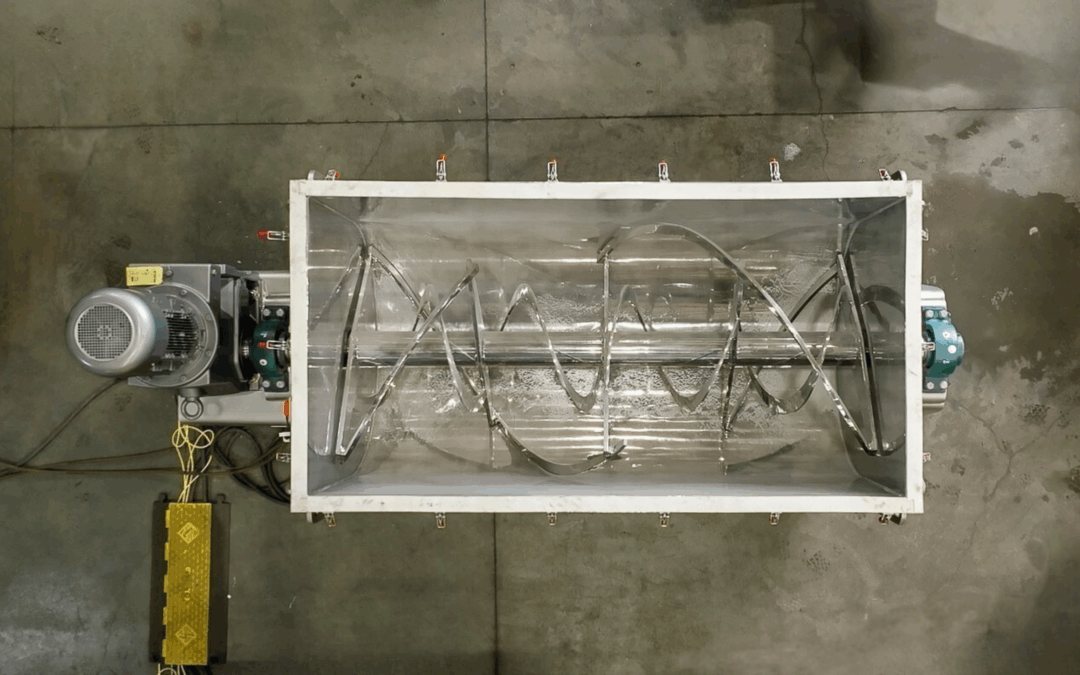
At Orbis Machinery, our Double Arm Mixers are designed specifically to address these composite processing challenges. Featuring two counter-rotating blades (sigma, dispersion, masticator or Naben), these mixers deliver superior kneading, folding, and shear, all within a controlled environment. Blade action can be configured as tangential, overlapping, or Naben, depending on your application.

Key Benefits of Double Arm Mixers for Composites:

Uniform Fiber Dispersion: The intermeshing blades promote complete distribution without damaging fiber length or integrity.

Scalable Consistency: From pilot-scale batches to continuous production, the same level of fiber homogeneity is maintained.

Gentle Yet Thorough Shear: Enough force to achieve full resin wetting, without over-mixing or generating excessive heat.

Custom Configuration: Trough geometry, discharge method, and blade shape are all engineered to your process requirements.

Fiber-Filled Composite Materials: Applications on the Rise


Industries are increasingly demanding stronger, lighter, and more sustainable materials. That’s why consistent fiber dispersion isn’t just a quality issue, it’s a competitive advantage.

Market Trends Driving Demand for Better Mixing:

Automotive & Aerospace: Light weighting goals are pushing for stronger composite panels with long fiber reinforcement.

Construction & Infrastructure: Pultruded and molded parts need reliable fiber/resin ratios to ensure long-term performance.

Bio-Based Composites: Natural fibers like flax, hemp, or recycled carbon fiber are harder to disperse uniformly, raising the need for advanced mixing technology.

Sustainability Mandates: Consistency is essential when substituting virgin materials with reclaimed or recycled inputs.

Mixing inconsistency in any of these applications can create downtime, rework, or scrap, adding costs and risking compliance with stringent industry specifications.

Why Off-the-Shelf Mixers Don’t Cut It


Most off-the-shelf mixing equipment isn’t designed for the demands of composite materials.

Generic designs often lack:

● Adequate torque or blade strength for viscous resin-fiber blends

● The control needed for heat-sensitive materials

● Configurability for evolving fiber types, viscosities, and filler loads

At Orbis, we believe your mixer should match your process, not the other way around. That’s why every Double Arm Mixer is engineered to order, based on your batch size, material rheology, throughput needs, and integration requirements.

How Orbis Machinery Delivers an Engineered Mixing Solution


When you partner with Orbis, you’re not just purchasing a piece of equipment, you’re investing in a purpose-built solution backed by decades of engineering expertise.

What Sets Us Apart:

Custom Blade Designs to balance shear and folding for delicate or aggressive mixing

Discharge Options like bottom dump, tilt, or auger for efficient handling of fiber-rich batches

Heat Management Integration via jacketed troughs or cooling elements

Support from Concept to Commissioning, including consultation, CAD drawings, testing, and service

Smart Buyers Ask This: “How Do I Know It Wil Work for My Material?”


Great question. And the answer lies in our consultative approach. We work with your engineers to understand fiber types, resin viscosity, filler ratios, and thermal limitations. From there, we design a mixing system that’s tailor-made for your process.

If you’re not getting consistent results today or you’re scaling up and need more control our team can help you select or configure the right system for your facility.

Final Thoughts: Don’t Let Your Mix Limit Your Composite Performance

If you’re working with fiber-filled compounds and struggling with inconsistency, Orbis’s Double Arm Mixers offer a solution that’s both robust and customizable. Reliable fiber dispersion means better product performance, reduced waste, and fewer surprises on the production floor.

 

Ready to upgrade your mixing process?

Talk to Our Team or Visit our Double Arm Mixer Page

Most people never think about how the products they use every day are made.

Whether it’s the ceramic tile in your kitchen, the battery powering your phone, the paint on your walls, or the materials used in aerospace and medical applications, many products begin as raw powders. Before those powders become finished goods, they go through a series of processing steps that determine everything from product quality to production efficiency.

But while every step matters, there’s one thing manufacturers learn quickly: the process is only as reliable as the equipment behind it.


It All Starts with the Material

Raw materials rarely arrive in the perfect condition needed for production. They often need to be blended, dried, classified, or reduced to a specific particle size before they can move to the next stage.

That may sound straightforward, but small inconsistencies can create big problems.

A slight variation in particle size can affect how materials blend. Poorly processed material can impact product performance. And when production schedules are tight, even a brief interruption can create a ripple effect throughout the entire operation.

That’s why manufacturers place so much emphasis on consistency from the very beginning.


The Step That Often Determines Everything Else

Every stage of powder processing contributes to the quality of the finished product, but particle size reduction often has the greatest influence on everything that follows.

In industries like ceramics, even small variations in particle size can affect surface finish, strength, and overall product quality. Consistent milling helps manufacturers maintain tighter process control from batch to batch.

This is where ball mills play a critical role.

For decades, ball mills have been one of the most trusted methods for achieving uniform particle size and creating consistency throughout the manufacturing process. While the technology itself is proven, what really matters is how reliably the equipment performs over time.

Because in manufacturing, consistency isn’t achieved through occasional success. It’s achieved through repeatable performance every single day.


The Reality of Downtime

Ask any plant manager what keeps them up at night, and there’s a good chance downtime will be near the top of the list.

When a critical piece of equipment goes down, production doesn’t just slow down—it can stop altogether.

Production schedules slip. Customer delivery dates get pushed back. Operators sit idle while maintenance teams troubleshoot the issue. What starts as a maintenance problem can quickly become a much larger business challenge.

That’s why reliability isn’t simply a maintenance concern. It’s a production concern. It’s a profitability concern. And in many cases, it’s a customer satisfaction concern.

Manufacturers don’t just need equipment that works. They need equipment they can count on.


Built for the Long Haul

The best processing equipment isn’t necessarily the equipment with the most features. It’s the equipment that shows up every day and does its job.

Industrial environments are demanding. Equipment faces abrasive materials, long operating hours, and constant production pressure. Reliability isn’t something that’s added later—it’s something that must be engineered into the machine from the beginning.

That’s one reason ball mills continue to be trusted across so many industries. When designed and built correctly, they provide dependable performance for years while helping manufacturers maintain consistent product quality.

In many cases, the lowest-cost machine becomes the most expensive option when maintenance costs, replacement parts, and lost production time are taken into account. That’s why experienced manufacturers evaluate equipment based on total cost of ownership, not just the initial purchase price.


Why Reliability Matters More Than Ever

For decades, Orbis Machinery has worked with manufacturers across industries to solve particle size reduction challenges and improve process reliability.

In today’s manufacturing environment, reliable equipment becomes more than a production asset—it becomes a competitive advantage.

Reliable milling equipment helps create predictable outcomes, reduce waste, minimize downtime, and support long-term operational success. When manufacturers can trust their equipment, they can focus less on troubleshooting and more on growing their business.


Ready to Improve Your Milling Process?

Whether you’re replacing aging equipment, expanding production capacity, or looking to improve particle size consistency, the team at Orbis Machinery can help identify the right milling solution for your operation.

Our ball mills are built to deliver dependable performance, consistent results, and long-term value for manufacturers across a wide range of industries.

From advanced ceramics and battery materials to paints, minerals, and specialty chemicals, the products people depend on every day begin with a reliable manufacturing process. And that process depends on equipment manufacturers can trust.

Contact Orbis Machinery today to discuss your application and discover how a dependable ball mill can help improve consistency, reduce downtime, and keep production moving for years to come.

In manufacturing, every finished product starts with a process. And every successful process starts with equipment you can trust.

Because when production depends on performance, reliability isn’t optional—it’s everything.