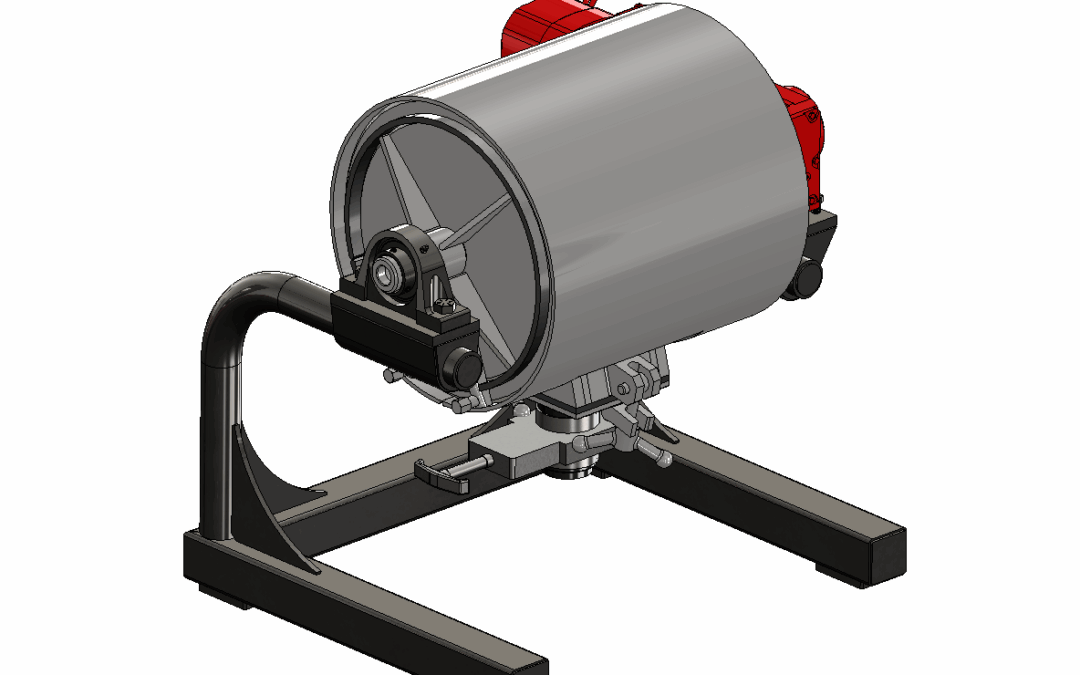
Action inside a Ball Mill drum is not a haphazard process. Stirring is not random nor is the throwing of the charge. There is a very specific operating speed for the most efficient grinding. Depending upon the Mill’s speed, there is a point in which the load along the wall of the cylinder will break free and the grinding media will begin to cascade through several layers of the material. This breaking point is affected by several factors: speed of mill, amount of material, amount of grinding media, and viscosity in the case of wet grinding.

Speed of Mill

Back in the old days, operating speeds where obtained through trial and error. Now, we are able to determine practical operating speeds by using the formula 54.19 divided by the square root of the radius in feet. Faster RPM are required for smaller mills to reach critical speed.

To minimize any grinding or dispersion issues, we aim for the cascading action discussed prior. The most desirable angle to accomplish this falls between 50 to 60° from horizontal. The lower end of this range applies to wet grinding applications for soft materials. The higher break point is reserved for harder wet grinding materials such as enamel as well as dry materials. This angle of break is also determinate upon the size of the mill. Since grinding actions in a larger mill are more severe than that of a smaller mill, the angle of break should be lower for the larger Mills than the smaller.

Media and Product Loading

For best results, the Mill should be filled half full with grinding media. While some operators choose to go slightly above this amount to compensate for wear, we recommend a limit of 5%.

NOTE: With media load at 50%, voids are created equal to 20% of cylinder volume. These voids are filled when product is loaded into the mill. Mills can be loaded by volume or by weight based on product’s bulk density.
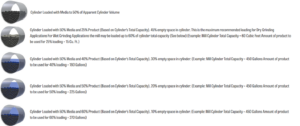
Orbis Machinery LLC Cylinder Load Statistics

Type of Grinding Media                                                                                            

Two types of grinding media are most commonly used: porcelain and metal balls.

Porcelain balls are made of a pure white ceramic material that due to its vitrified body and high density, will not become damaged while in use. In recent years, their quality has improved immensely and they are now used exclusively in a number of industries.

Despite a rough start in the industry due to contamination issues, metal options have made vast improvements since they were first introduced. Though there is a number of metal media options, steel balls are used far more often than most as they complete grinding jobs fast than any other available media.

Size of Grinding Media

One of the most common reasons for complains and faulty operations falls on the size of the grinding media. We recommend that the smallest possible media be used in all cases. When optimum media size is discovered in a laboratory sample, the same media should be used regardless of mill size. Small media is recommended as it provides more grinding contacts than larger media, which in turn results in quicker grinding. The smaller voids also limit the size of particles that can occur there. The largest drawback of large media that is alleviated with a smaller option is that of excess energy. Oversized media often develops more grinding energy than the job requires. This excess energy does nothing other than create heat and wear down the lining and media. Though there are numerous benefits to a smaller grinding media, there is one drawback. Due to increased surface tension in the small voids, discharge takes somewhat longer. This disadvantage is far outweighed by the faster grinding times.

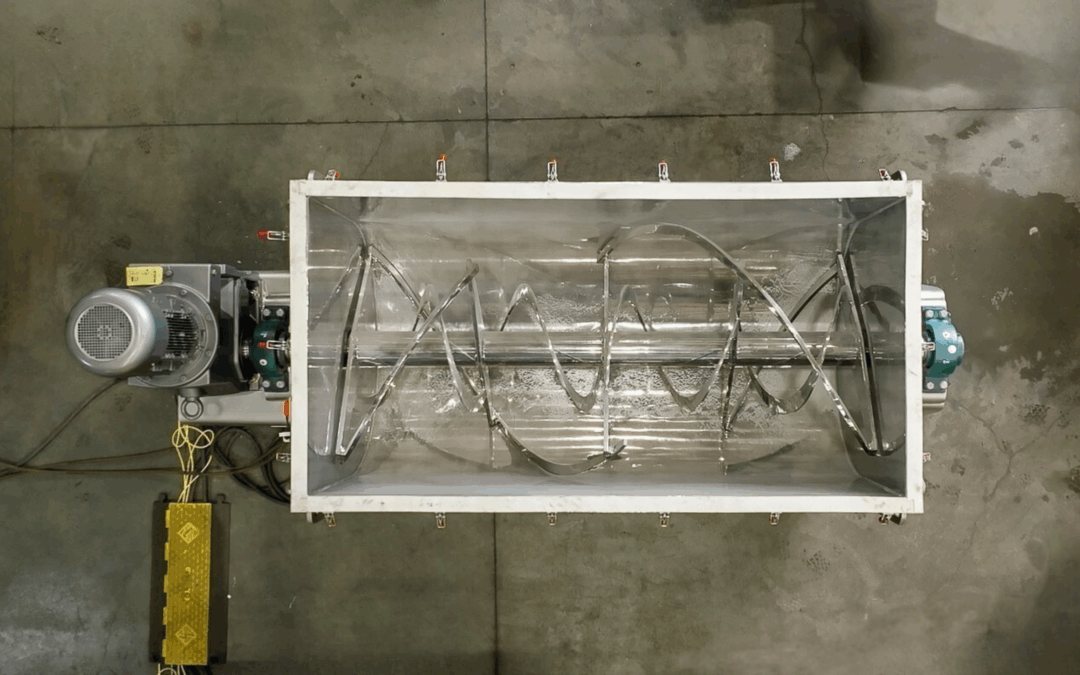
Ball Mills. (2017, October 23). Retrieved from https://www.911metallurgist.com/blog/ball-mills

Most people never think about how the products they use every day are made.

Whether it’s the ceramic tile in your kitchen, the battery powering your phone, the paint on your walls, or the materials used in aerospace and medical applications, many products begin as raw powders. Before those powders become finished goods, they go through a series of processing steps that determine everything from product quality to production efficiency.

But while every step matters, there’s one thing manufacturers learn quickly: the process is only as reliable as the equipment behind it.


It All Starts with the Material

Raw materials rarely arrive in the perfect condition needed for production. They often need to be blended, dried, classified, or reduced to a specific particle size before they can move to the next stage.

That may sound straightforward, but small inconsistencies can create big problems.

A slight variation in particle size can affect how materials blend. Poorly processed material can impact product performance. And when production schedules are tight, even a brief interruption can create a ripple effect throughout the entire operation.

That’s why manufacturers place so much emphasis on consistency from the very beginning.


The Step That Often Determines Everything Else

Every stage of powder processing contributes to the quality of the finished product, but particle size reduction often has the greatest influence on everything that follows.

In industries like ceramics, even small variations in particle size can affect surface finish, strength, and overall product quality. Consistent milling helps manufacturers maintain tighter process control from batch to batch.

This is where ball mills play a critical role.

For decades, ball mills have been one of the most trusted methods for achieving uniform particle size and creating consistency throughout the manufacturing process. While the technology itself is proven, what really matters is how reliably the equipment performs over time.

Because in manufacturing, consistency isn’t achieved through occasional success. It’s achieved through repeatable performance every single day.


The Reality of Downtime

Ask any plant manager what keeps them up at night, and there’s a good chance downtime will be near the top of the list.

When a critical piece of equipment goes down, production doesn’t just slow down—it can stop altogether.

Production schedules slip. Customer delivery dates get pushed back. Operators sit idle while maintenance teams troubleshoot the issue. What starts as a maintenance problem can quickly become a much larger business challenge.

That’s why reliability isn’t simply a maintenance concern. It’s a production concern. It’s a profitability concern. And in many cases, it’s a customer satisfaction concern.

Manufacturers don’t just need equipment that works. They need equipment they can count on.


Built for the Long Haul

The best processing equipment isn’t necessarily the equipment with the most features. It’s the equipment that shows up every day and does its job.

Industrial environments are demanding. Equipment faces abrasive materials, long operating hours, and constant production pressure. Reliability isn’t something that’s added later—it’s something that must be engineered into the machine from the beginning.

That’s one reason ball mills continue to be trusted across so many industries. When designed and built correctly, they provide dependable performance for years while helping manufacturers maintain consistent product quality.

In many cases, the lowest-cost machine becomes the most expensive option when maintenance costs, replacement parts, and lost production time are taken into account. That’s why experienced manufacturers evaluate equipment based on total cost of ownership, not just the initial purchase price.


Why Reliability Matters More Than Ever

For decades, Orbis Machinery has worked with manufacturers across industries to solve particle size reduction challenges and improve process reliability.

In today’s manufacturing environment, reliable equipment becomes more than a production asset—it becomes a competitive advantage.

Reliable milling equipment helps create predictable outcomes, reduce waste, minimize downtime, and support long-term operational success. When manufacturers can trust their equipment, they can focus less on troubleshooting and more on growing their business.


Ready to Improve Your Milling Process?

Whether you’re replacing aging equipment, expanding production capacity, or looking to improve particle size consistency, the team at Orbis Machinery can help identify the right milling solution for your operation.

Our ball mills are built to deliver dependable performance, consistent results, and long-term value for manufacturers across a wide range of industries.

From advanced ceramics and battery materials to paints, minerals, and specialty chemicals, the products people depend on every day begin with a reliable manufacturing process. And that process depends on equipment manufacturers can trust.

Contact Orbis Machinery today to discuss your application and discover how a dependable ball mill can help improve consistency, reduce downtime, and keep production moving for years to come.

In manufacturing, every finished product starts with a process. And every successful process starts with equipment you can trust.

Because when production depends on performance, reliability isn’t optional—it’s everything.