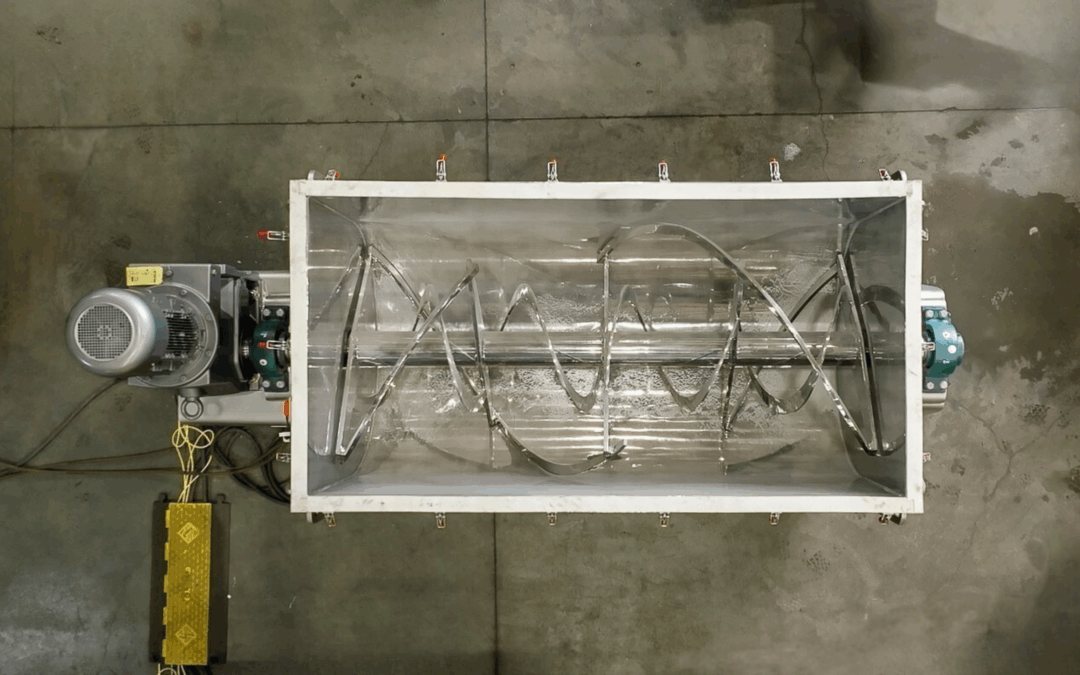
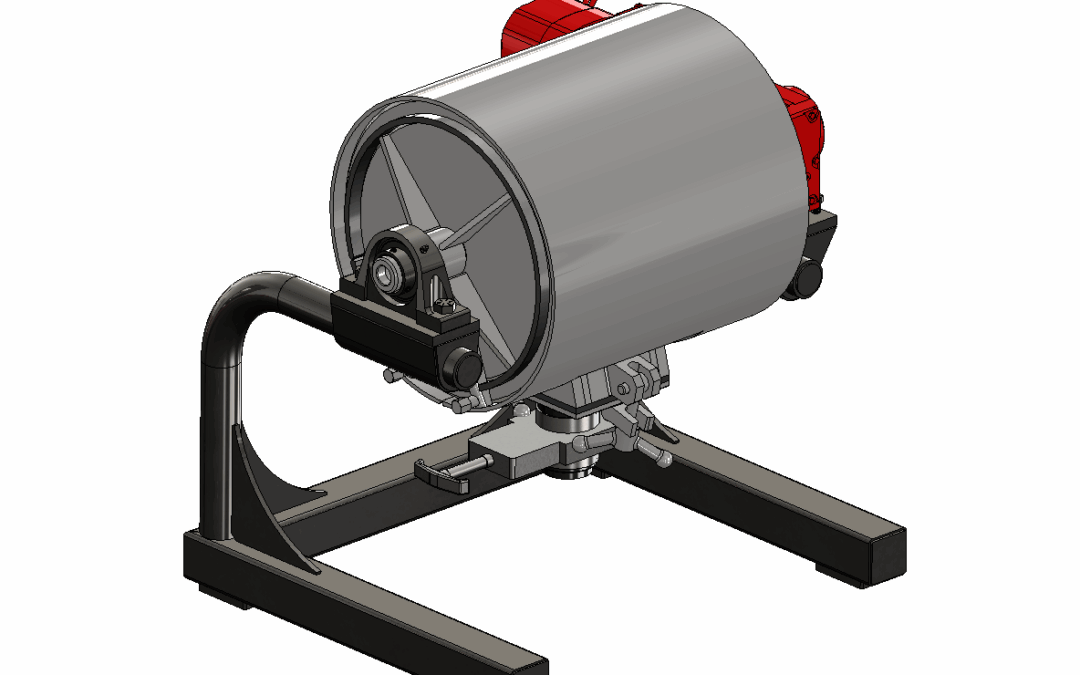
Double Arm Mixers or Malaxeurs are designed specifically for mixing, homogenizing and, kneading profoundly thick products. Two shaped blades sitting parallel at the base of the blending trough, give intensive blending.
The sharp blades rotate at various speeds in inverse ways making the products to transfer from one blade to another and from start to finish, bringing about the pattern of figure eight. The release of the product can be successful by a few strategies. The blending trough can be tilted up and forward using a hydraulic framework. Valves can be situated in the base of the unit, enabling the item to release through the plug, ball, or bomb cove type valves.
A third strategy, which has a few focal points, is the utilization of an expulsion screw to release the product in a shape, or specifically to the following period of processing. Basically, Double Arm Mixers or Malaxeurs are two terms for the same piece of equipment. Double Arm Mixer is used primarily in the US where Malaxeur is used in many European countries.
Why the split occurred
Continental Europe spoke for the Baker Perkins, both a home and an opportunity of some of the strongest competitors. For a long time it liked to serve the market through the agents, supported by the visits from key faculty, and by building the strong business and the technical relationships with the well-established Continental hardware makers who could supply technology and that complemented the Baker Perkins own. Malaxeurs Guittard was developed by the Baker Perkins Holdings for £1.113m in the year of 1978 in the month of March giving Baker Perkins its first entirely owned manufacturing facility on Europe’s Continent. It manufactured a large range of advanced mixtures using plastics, food industries employing 70.
The beginning of conflict
Baker Perkins Guittard became an important part of group’s global chemical hardware division of the Baker Perkins Inc. Saginaw. Guittard mixers were to be manufactured in the Paris and sold around the world. The requirements of overflow were to originate from the Stoke-on-Trent industrial facility with the Baker Perkins Inc. giving expansive advertising bearing in the USA however with the US agent of the Guittard’s, Jaygo, taking care of the majority of the deals.
Baker Perkins Guittard just made back the initial investment in 1980/81 yet showed good and worthy improvement in both the profit and sales in the next year. The organization, for the most part, performed superior to anything its bigger American sub-group partner, influencing good benefits to up to the season of the merger with APV in 1987 regardless of a depressed global market. Toward the start of 1983, Baker Perkins Guittard turned out to be a part of the procedure hardware division of Baker Perkins Inc. headed by Bernie Lieberman. Baker Perkins Guittard additionally went about as a specialist in France for items manufactured at both Stoke-on-Trent and Saginaw. The factory of the Chelles became the main center of the group for the design, manufacture, and development of the horizontal mixers of the batch and even horizontal batch extruders. The company won the order jointly with Baker Perkins Inc. in 1983, for what were believed to be the world’s biggest mixers.
A significant part of the hardware provided by Baker Perkins Guittard was for particular applications and a test client or laboratory demonstration center was proved to be a significant aid both to the design engineers and the sales of the company. The current focus at Chelles was doubled in size in the year 1983.
- By September 15, 1977, all the chemical personnel located at the Peterborough had moved to the first premises of Steele and Cowlishaw at Stoke-on-Trent that was new headquarters of the BPCM.
- Another lab for research, development, and demonstration on the compounding equipment and heavy mixing was operational by September’s end.
- In 1978, Baker Perkins Inc reported an agreement signed with the Durr and Clay Investments Corp. of Indianapolis that provide Saginaw with the exclusive rights of manufacturing as well as non-exclusive marketing rights in the USA for DCI’s range of the Dyna products. These were utilized in the recovery of the solvents from gaseous or liquid waste streams.
- In the mid-1978, Baker Perkins Holdings procured Malaxeurs Guittard of Paris, proceeding with group’s rationalization and extension of its allied and chemical interests in Europe.
- After two years, in March 1980, another manufacturing entity was obtained in Europe, Pavailler SA, originators and producers in France and Italy of a wide range of ovens and machinery for the small artisan bakeries. Pavailler likewise had branch workplaces in Germany – Pavailler Deutschland GmbH and in Belgium, Pavailler Belgium SA.
- Likewise in the year 1980, subsidiary of the Baker Perkins Chemical Machinery Ltd, Baker Perkins Chemical Machinery Srl was framed to sell and service the Chemical division products in Italy.
Introduction of Simplex stove
What was known to be the biggest bakery on the planet outside the Americas and the UK and the main Australian-claimed bakery in Europe was the goal, in 1970, of a huge bread baking stove designed and built by the Baker Perkins Pty, Australia. The 64 feet by 11 feet by 11 feet 80-plate Simplex stove that weighs 34 tons and was sent to Greece in two parts as deck load on the ‘Northumberland’. Completely equipped and programmed for creating 4,000 bread loaves per hour – requiring just two men to work it – the stove was the main shipment of more than 230,000 worth of Baker Perkins provided hardware.
If you want to update or replace your double arm mixer, picking the correct unit can be a challenge. Given the huge range of options to browse and intended usage of the product, that buy speaks to a critical venture to numerous individuals. Luckily, by having a superior comprehension of the thing you are looking for and realizing what benefits are related to the correct buy, you can make sure that you have made a good decision. All in all, the correct double arm mixer can profit your business for quite a long time to come. Since it’s probably going to be a major project that will be utilized for a long time, narrowing down the potential outcomes by making some inquiries of everything you may decide on will be very helpful.
History of Baker Perkins in Europe. (n.d.). Retrieved from https://www.bphs.net/ServingTheWorld/BPEurope.htm
The History of Baker Perkins Guittard, Chelles, Paris, France. (n.d.). Retrieved from https://www.bphs.net/GroupFacilities/B/BPGuittard.htm